

Enzyme-based solutions are becoming key drivers of innovation and performance across industries such as cosmetics, detergents, food, biotechnology and life sciences. Thanks to their remarkable efficiency and selectivity, enzymes accelerate specific chemical reactions, enabling manufacturers to develop higher-performing, more sustainable and higher-value products.
However, these natural catalysts all share one major biological limitation: they are highly sensitive to environmental conditions, particularly temperature fluctuations.
For manufacturers, the loss of enzyme activity during processing, drying or long-term storage can have serious consequences. Reduced enzyme performance directly impacts product quality, increases raw material waste and may ultimately lead to finished products that fail to meet customer expectations.
Managing enzyme heat sensitivity cannot be left to chance. It requires a comprehensive approach combining protective formulation, carefully controlled storage conditions and processing methods specifically adapted to industrial constraints.
In this in-depth guide, discover the mechanisms behind thermal degradation, the most effective strategies for protecting your active ingredients, and how partnering with a leading expert such as INNOV’IA can transform technical challenges into competitive advantages.

1. Understanding Heat Sensitivity: Why and How Do Your Enzymes Lose Their Effectiveness?
The Critical Impact of Temperature on the Active Site
Understanding the fragility of an enzyme begins with its native structure. Enzymes are three-dimensional proteins whose performance depends entirely on preserving their highly precise molecular architecture. At the heart of this complex structure lies the active site—a microscopic cavity specifically shaped to recognize and convert a target molecule (the substrate), much like a key fitting into a lock.
When exposed to elevated temperatures or sudden thermal fluctuations, the additional kinetic energy weakens and eventually breaks the weak molecular interactions—such as hydrogen bonds and hydrophobic interactions—that maintain the enzyme’s three-dimensional structure.
As a result, the active site’s architecture becomes permanently altered, preventing the enzyme from properly binding to its substrate. Once the geometry of this molecular “lock” is compromised, molecular recognition is lost, enzyme activity rapidly declines, and the active ingredient is considered thermally denatured.
Effectively protecting enzyme-based ingredients therefore requires minimizing heat exposure while stabilizing their delicate molecular structure.
The Hidden Risks of Temperature Fluctuations and Improper Cold Storage
Although excessive heat is the most obvious threat to protein integrity, low temperatures and freezing can be equally damaging when not properly controlled.
Keeping enzyme preparations refrigerated—typically between 0°C and 4°C—is recommended to slow thermal denaturation and extend shelf life.
Conversely, uncontrolled freezing represents a major technological challenge. During slow or poorly managed freezing, the water contained within the formulation forms large ice crystals capable of generating significant mechanical stress and localized osmotic pressure.
These ice crystals may irreversibly damage the three-dimensional structure of sensitive enzymes. Effective protection therefore requires a comprehensive strategy that safeguards enzymes not only against heat, but also against the harmful effects of uncontrolled phase changes.
2. Essential Strategies to Protect and Stabilize Your Enzymatic Active Ingredients
To overcome these physical constraints, formulation science and advanced powder processing technologies provide several effective strategies for improving enzyme stability.
- Strict temperature control: For liquid formulations, maintaining enzyme preparations at a constant refrigerated temperature (typically between 0°C and 4°C) is essential to minimize molecular motion and preserve their native structure.
- Immobilization on solid supports: When enzymes are intended for continuous industrial processes or stirred reactors, immobilization onto a solid support provides an effective stabilization strategy. By chemically or physically binding the enzyme to an insoluble rigid matrix, its structural flexibility is reduced, significantly improving operational stability, preventing activity loss and enabling repeated reuse.
3. From Industrial Process to Finished Product: Building a Tailor-Made Formulation Strategy
The Enzyme–Matrix Pair: Why Customization Is Essential
In formulation engineering, there is no universal or one-size-fits-all solution. Every enzyme family—whether proteases, lipases, amylases or others—has its own structural characteristics and specific thermal sensitivity. Each enzyme responds differently to heat, cold and environmental conditions.
Selecting the optimal stabilization strategy therefore depends on the specific enzyme–matrix combination as well as the storage conditions and performance requirements of the final application.
Whether your active ingredient is intended for a cosmetic product (cream or serum), a detergent (liquid or powder laundry detergent), or an advanced biotechnology formulation, both the protective excipients and the carrier matrix must be designed together.
The objective is to create the ideal synergy in which the formulation protects the enzyme from external stresses while preserving its activity and bioavailability throughout the product’s shelf life and during use.
Mastering the Product Environment: pH, Moisture and Ingredient Compatibility
Beyond temperature control during manufacturing, the chemical environment within the finished product has a direct impact on enzyme stability and shelf life.
To preserve the integrity of the active site over time, formulators must carefully control several key parameters:
pH: Variations in pH can alter the electrical charges of the amino acids forming the active site, leading to enzyme inactivation or denaturation.
Moisture and free water: Excess moisture may trigger premature hydrolysis reactions or accelerate thermal degradation by increasing molecular mobility.
Salt and ionic concentration: Ionic balance plays a key role in stabilizing—or destabilizing—the internal salt bridges that maintain enzyme structure.
Compatibility with other ingredients: Aggressive surfactants, preservatives or oxidizing agents may damage the enzyme’s natural protective environment and reduce its activity.
The Golden Rule: Validate Your Formulation with Real-World Stability Testing
To reliably protect your active ingredients before industrial production begins, one principle should always guide formulation development: combine stable storage conditions with a highly protective formulation.
Accelerated ageing studies and real-time stability testing make it possible to monitor residual enzyme activity over time and scientifically validate the effectiveness of the selected protection strategy before commercial launch or large-scale manufacturing.
4. INNOV’IA Expertise: Your Trusted Partner for Protecting Your Innovations
Turning scientific expertise into robust industrial solutions requires the support of a specialist in advanced powder processing technologies. INNOV’IA leverages decades of experience to protect, stabilize and enhance your most sensitive active ingredients.
End-to-End Support: From Laboratory Development to Industrial Scale-Up
With extensive expertise in formulation and powder processing, INNOV’IA supports manufacturers throughout every stage of product development.
Our mission is to help customers formulate, develop and manufacture complex, tailor-made functional ingredients.
Our integrated co-development approach secures every step of the innovation process—from laboratory research and proof of concept to pilot-scale validation and full industrial scale-up.
Advanced Technologies to Shape and Protect Your Powders
To thermally protect enzymes and isolate them from aggressive formulation environments, INNOV’IA offers a comprehensive portfolio of advanced powder processing technologies.
Microencapsulation encloses enzymes within tailor-made protective microcapsules, shielding them from heat, moisture and incompatible ingredients while ensuring targeted release when required.
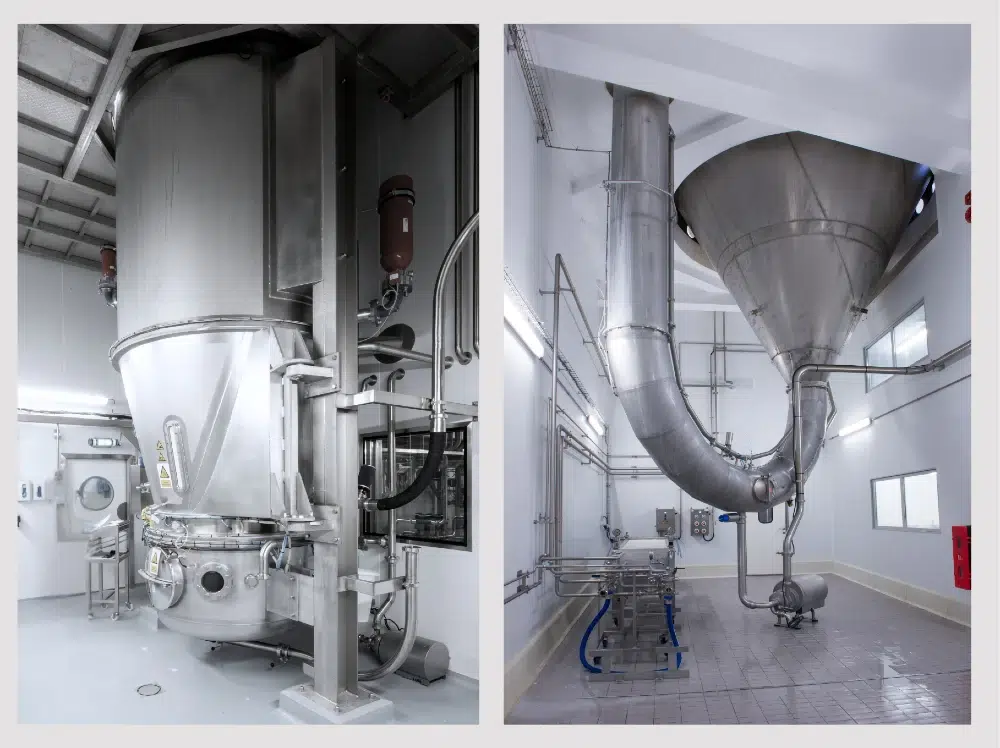
Our highly controlled, ultra-fast spray drying process instantly converts emulsions and liquid suspensions into stable powders while minimizing thermal exposure to preserve enzyme activity.
Coating and Granulation
Coating technologies create a uniform protective layer around particles, while granulation improves flowability, bulk density and the mechanical strength of enzymatic powders.
Prilling and Fluidized Bed Agglomeration
These technologies are ideal for producing dust-free beads or granules with rapid dissolution or controlled-release properties, enhancing both user experience and product performance.
Industrial Capacity Backed by Research Excellence
To successfully bring your innovations to industrial scale, the INNOV’IA Group combines robust manufacturing capabilities with high-level scientific expertise.
Major industrial capacity
INNOV’IA operates four production facilities in France, including its strategic manufacturing sites in La Rochelle and Segré, providing operational flexibility and supply security.
State-of-the-art production equipment
Our industrial platform includes a total of 13 fluidized bed units, 9 spray drying towers and 2 prilling units, enabling us to process a wide variety of powders and production volumes.
Proven manufacturing capacity
More than 11,000 tonnes of functional ingredients were produced in 2025.
Integrated Research & Innovation
Located in La Rochelle, the Capsulæ Research & Innovation Center brings together more than 35 researchers and encapsulation experts, backed by over 35 years of expertise in encapsulation technologies. Their work supports continuous innovation, technology monitoring and the development of robust Proofs of Concept (PoCs).
Rigorous Compliance and Internationally Recognized Certifications
Because regulatory compliance and product safety are essential for international markets, quality lies at the heart of INNOV’IA’s industrial commitment.
Our internationally recognized certifications (available upon request) include:
| Certification | Target Markets & Applications |
| FSSC 22000 | International food safety certification for food ingredients and infant nutrition. |
| GMP Part II | Good Manufacturing Practices for pharmaceutical and cosmetic applications. |
| FAMI-QS | Quality and safety management system dedicated to animal nutrition ingredients. |
| Organic, Kosher and Halal | Certifications available upon request to meet specific regulatory, ethical or cultural requirements. |
In line with growing environmental expectations, INNOV’IA has also invested more than €7 million in environmentally efficient technologies across its production facilities to reduce the carbon footprint of its industrial operations while maintaining outstanding manufacturing performance.
Conclusion: Maximize the Performance and Stability of Your Active Ingredients
Successfully managing enzyme heat sensitivity is a critical factor in the industrial performance of enzyme-based products. By understanding the mechanisms that affect enzyme activity and implementing formulation strategies tailored to the specific enzyme–matrix combination, manufacturers can transform a biological constraint into a lasting competitive advantage.
Don’t let temperature fluctuations or storage constraints compromise the performance of your formulations. By leveraging INNOV’IA’s industrial expertise, advanced powder processing technologies and tailor-made support, you can protect your active ingredients from laboratory development through to full-scale contract manufacturing.
Looking to improve the stability and protection of your enzymatic active ingredients?
Contact INNOV’IA’s engineers and formulation experts today to discuss your specifications, schedule feasibility trials or request a customized quotation for your industrial production project.
Advanced FAQ: Going Further in Enzyme Stabilization
Table of contents
Contact-us
"*" indicates required fields