
In the food and pharmaceutical industries, powder solubility is a major technical challenge. Lump formation and water resistance negatively impact product quality and industrial performance. Instantization, through lecithination, agglomeration, or spray drying, modifies particle structure to enable rapid dispersion. Optimize the functionality of your ingredients and ensure a perfect user experience with advanced processes tailored to each matrix.

The Instant Solubility Challenge: Why Do Powders Form Lumps?
Lump formation is a common issue in the food and pharmaceutical industries. It mainly results from the water resistance of powders, preventing liquid from quickly penetrating into the particle core.
Excessively rapid peripheral hydration creates an impermeable gel barrier around the particles, blocking liquid diffusion and generating persistent lumps.
Fats and hydrophobic components further increase dispersion difficulty, making wettability particularly complex without appropriate treatment.
Industrial Implications of Poor Solubility
Incomplete dissolution leads to:
- Irregular texture and altered homogeneity of the finished product.
- Frequent clogging of production lines, generating raw material losses and increasing cleaning time and process downtime.
- Random dispersion of active ingredients, compromising dosing accuracy, nutritional or pharmacological efficacy, or resulting in an unpleasant consumer experience.
Ensuring instant solubility is therefore critical for quality, safety, industrial performance, and consumer satisfaction.
Instantization: Objectives and Principles
Instantization refers to a powder’s ability to disperse almost immediately in a liquid without intense agitation. Achieving this standard requires modifying particle surface and structure to optimize affinity with the solvent.
The technical objective is to make powder surfaces more hydrophilic and porous, promoting capillary penetration and réduisant significativement le temps time in complex matrices.
Several industrial approaches make this possible:
- Lecithination – surface treatment using an amphiphilic agent.
- Fluidized bed agglomeration – creation of porous granules to facilitate dissolution.
- Spray drying control – rapid conversion of a liquid into a microgranulated powder with optimized structure.
Lecithination: An Efficient Surface Treatment
Lecithin (soy or sunflower) is an amphiphilic phospholipid that modifies particle surface properties.
- The hydrophilic head attracts water.
- The lipophilic tail binds fats.
Mechanism of action: lecithin forms a film around particles, reducing surface tension and facilitating liquid penetration into agglomerates. The formation of a gel barrier is avoided, allowing homogeneous and nearly instantaneous dispersion.
Industrial benefits:
- Rapid dispersion in hot or cold liquids.
- Smooth, homogeneous, and pleasant texture.
- Simplified preparation and optimal user experience.

Fluidized Bed Agglomeration: Creating a Porous Structure
Fluidized bed agglomeration consists of suspending fine particles in a stream of hot air and binding them using a binder or wetting agent.
The granules formed are larger and porous, promoting instant dissolution.
The process also reduces dust formation and improves operator safety.
Benefits: rapid dispersion, improved homogeneity, reduced stickiness, and lump prevention.
Spray Drying: An Integrated Approach
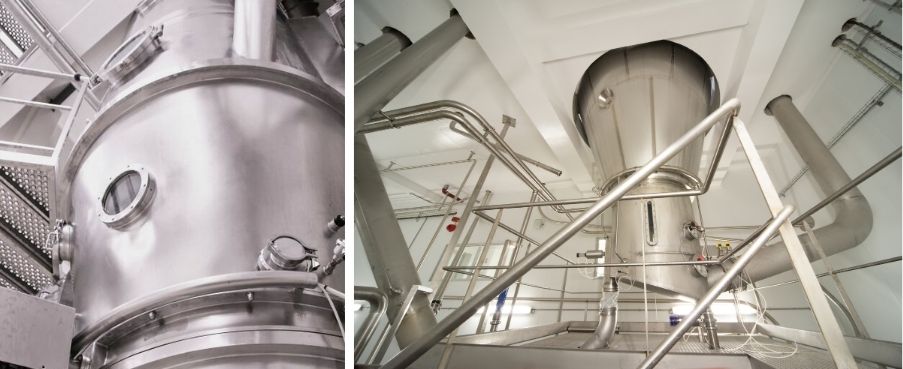
Spray drying transforms a liquid into a fine or microgranulated powder within seconds.
The liquid matrix is dried in a stream of hot air; powder recirculation can enable microgranulation, ensuring that each particle possesses the necessary functionality for instant dispersion.
Mastery of spray drying, combined with rigorous particle size control, ensures optimal functional performance and stability.
Benefits: perfect homogeneity, improved solubility, protection of heat-sensitive ingredients.
Process Control: The Key to Performance
Successful instantization depends on controlling several critical variables:
- Particle size and wetting agent droplet size.
- Drying air temperature and flow rate.
- Residence time in the equipment.
- Dosage of wetting agent relative to powder mass.
Only an experienced partner can adjust these parameters to guarantee a customized and reproducible result, transforming a raw powder into a highly functional ingredient.
Matrix Analysis: Every Powder Is Unique
There is no universal formulation solution to guarantee performance. A high-fat milk powder does not behave mechanically like a plant protein powder.
An R&D and prototyping phase is systematically required prior to production. This step, conducted on semi-industrial pilot equipment, allows different strategies to be tested and technical feasibility to be validated.
Ingredient functionalization lies in adapting physical characteristics to final formulation constraints. This technical approach ensures a stable and high-performing product.
Method Comparison by Powder Type
| Type of powder | Main challege | Recommended process | Key benefit |
| Whole Milk Powder | High fat content | Agglomeration + lecithination | Excellent wettability and prevention of fat migration |
| Plant Protein Powder | Hydrophobic nature and taste | Spray drying with lecithin and masking agent | Improved solubility and neutral organoleptic profile |
| Chocolate Drink Mix | Very fine and volatile powder | Agglomeration | Dust suppression and instant dispersion without residue |
The Value of an Expert CDMO Partner
A CDMO (Contract Development and Manufacturing Organization) is a partner responsible for process development and production. This expertise covers the entire lifecycle, from pilot scale to full industrial production.
Confidentiality is a cornerstone of this technical collaboration. A pure CDMO does not develop its own products, ensuring the complete absence of conflicts of interest with clients.
Access to a broad technology portfolio enables the design of the most relevant solution. Manufacturers are not limited to a single piece of equipment but benefit from optimal operational flexibility.
Sector Applications and Specific Requirements
Powder instantization is applied across multiple industries, each imposing specific requirements for solubility, homogeneity, and safety.
- Human and Infant Nutrition
This sector, particularly infant nutrition, imposes extremely strict hygiene and microbiological safety standards. Perfect solubility is not sufficient: each batch of instantized powder undergoes rigorous testing before release. Lecithination and agglomeration ensure rapid, homogeneous, lump-free dispersion while preserving the functionality of sensitive ingredients such as vitamins and probiotics. - Animal Nutrition
Powders intended for animal feed require protection of heat-sensitive ingredients and homogeneous dispersion in premixes. Coating or agglomeration, sometimes combined with lecithination, protects sensitive additives from thermal and mechanical stress, ensuring stability and nutritional efficacy. - Cosmetics and Pharmaceuticals
These industries require optimal dispersion of active ingredients in reconstitutable formulations (creams, pharmaceutical powders, dietary supplements). Poor dispersion can compromise efficacy and product appearance. Instantization through agglomeration or spray drying produces powders that are easy to rehydrate and perfectly homogeneous, meeting strict quality standards.
Summary of Key Applications
- Human and infant nutrition: milk powders, infant formula, instant beverages and preparations.
- Animal nutrition: premixes and sensitive formulations requiring protection and homogeneity.
- Cosmetics and pharmaceuticals: reconstitutable powders for topical or ingestible applications.
Instantization expertise combines functional performance, safety, and homogeneity, providing manufacturers with solutions tailored to the specific constraints of each market and production process.
The Importance of Quality Certifications
Industrial trust is not declared — it is demonstrated through tangible guarantees. Adherence to internationally recognized standards is no longer optional but a minimum requirement. These frameworks structure risk management and confirm operational control.
Specific certifications govern each sector to ensure compliance. FSSC 22000 guarantees food safety, GMP Part II applies to pharmaceuticals, and FAMI-QS to animal nutrition.
Selecting an industrial partner requires careful verification of certifications or accreditations. Compliance with these strict regulatory frameworks validates process robustness — the foundation of safety.
Conclusion
Mastering instantization processes is essential to transform complex powders into highly functional ingredients. This technical expertise guarantees perfect homogeneity and rigorous sanitary safety, ensuring product performance and consumer satisfaction.
Looking to optimize the solubility of your matrices? Rely on Innov’ia’s expertise. Our specialists support you from prototyping to industrial production. Contact Innov’ia today to turn your technical challenges into commercial success.
FAQ – Powder Instantization
Table of contents
Contact-us
"*" indicates required fields